


Boot height isn’t just about comfort or weather-it’s the silent architect of your entire look. The difference between a 2-inch block heel and a 4-inch stiletto doesn’t just change how you walk. It changes how your legs look, how your hips sit in your jeans, even how your coat drapes. Most people think boots are just footwear. They’re not. They’re visual tools. And like any tool, the size and shape of the heel and shaft determine what kind of job they do.
How Boot Height Alters Your Silhouette
Think of your body as a canvas and boots as the frame. A short boot-say, ankle height-cuts your leg at the narrowest point. That creates a visual stop. It makes your legs look shorter, especially if you’re wearing pants that sit at or above the ankle. On the flip side, a knee-high boot that hugs your leg from ankle to just below the knee extends the line. It creates the illusion of longer legs. That’s why so many women in New York wear knee-highs in winter: they make skinny jeans look like they were tailor-made for them.
But it’s not just about length. It’s about proportion. A tall boot with a narrow shaft draws attention upward. A wide shaft, like a cowboy boot, pulls the eye outward. That’s why pairing a wide-leg pant with a wide shaft boot can make you look wider than you are. But pair the same boot with a fitted skirt or slim pants, and the contrast creates balance. The boot becomes a visual anchor, not a visual bulk.
Heel Height: The Silent Scale
Heel height is the most underrated factor in boot styling. A 1-inch flat heel? That’s a neutral. It doesn’t change your posture. A 2-inch heel? That’s where magic starts. It lifts your arch, tilts your pelvis slightly forward, and naturally tightens your core. That subtle shift makes your waist look smaller and your hips more defined. You don’t need to be wearing a dress to feel it.
Now jump to a 3-inch heel. That’s the sweet spot for most people. It’s high enough to elongate the leg by about 1.5 inches visually, but low enough that you can walk across a crowded sidewalk without needing a cane. This is the height most fashion editors reach for when they’re styling for editorial shoots. It’s the height that makes boots look intentional, not just practical.
Go above 4 inches, and you’re in statement territory. A 4.5-inch stiletto boot doesn’t just elevate your height-it elevates your entire vibe. It makes your stance more confident, your walk more deliberate. But here’s the catch: it changes your center of gravity. Your body leans forward slightly to compensate. That means your coat or jacket will sit differently. Your shoulders might roll forward. Your hips might tuck. You’re not just wearing boots anymore. You’re wearing a posture.
Matching Boot Height to Your Body Type
Not everyone should wear the same boot. It’s not about trends. It’s about geometry.
If you’re petite-under 5’4”-ankle boots with a 2-inch heel are your best friend. They don’t cut your leg mid-calf, which can make you look chopped in half. A mid-calf boot with a slight heel (2.5 to 3 inches) works too, as long as the shaft isn’t too wide. Avoid knee-highs with flat soles-they swallow your frame. Instead, go for a slim, pointed-toe knee-high with a 3-inch heel. That creates a continuous line from foot to thigh.
If you’re tall-5’8” or above-you have more freedom. You can wear chunky platform boots with 3-inch heels and still look balanced. Tall women often make the mistake of thinking they need to wear the tallest boots possible. But that’s not true. A sleek ankle boot with a 1.5-inch heel can look just as powerful. The key is proportion. A tall person in a long coat and ankle boots looks intentional, not sloppy. A short person in the same outfit looks lost.
For curvy figures, the rule is simple: avoid boots that flare out at the calf. That draws attention to the widest part of your leg. Instead, go for a straight or slightly tapered shaft. A boot that hugs your calf without squeezing it creates a smooth silhouette. Heel height? Stick to 2.5 to 3.5 inches. That lifts your hips just enough to balance your curves without overdoing it.
Boot Shaft Length and Outfit Pairing
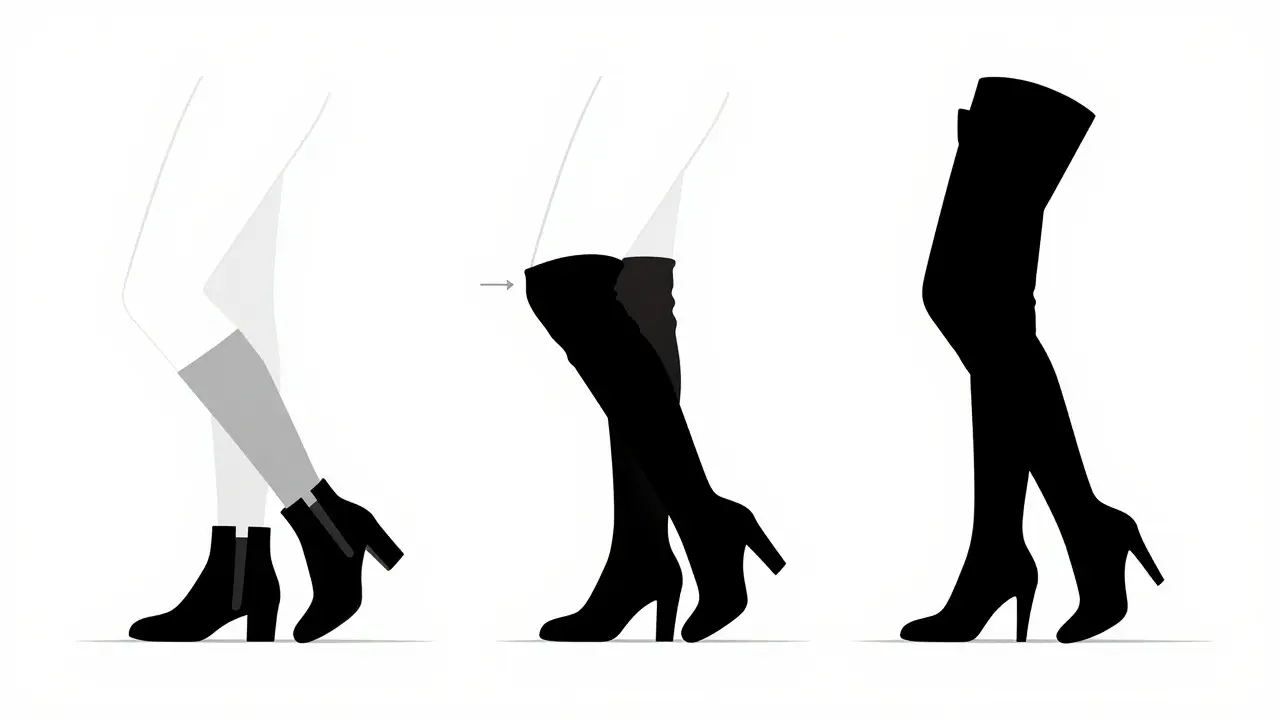
Shaft height matters just as much as heel height. Here’s the breakdown:
- Ankle boots (2-4 inches): Best with cropped pants, dresses that hit above the knee, or skirts with tights. Avoid with full-length pants unless the pant is slim and the boot is pointed.
- Calf boots (10-14 inches): Work with midi skirts, wide-leg pants, or long coats. They’re the bridge between casual and polished. A calf-height boot with a heel makes even denim look elevated.
- Knee-high boots (15-18 inches): Perfect with mini skirts, bodycon dresses, or skinny jeans. They eliminate the need for tights in winter. Avoid with loose, flowy pants-they create a balloon effect.
- Over-the-knee boots (19+ inches): Only work with short hemlines or fitted tops. Pair them with a long coat that hits mid-thigh for balance. Anything longer and you risk looking like you’re wearing two coats.
Here’s a real example: A woman in Brooklyn wore a black over-the-knee boot with a 3-inch heel and a long, oversized blazer. The blazer hit mid-thigh. The boot hit just above the knee. The space between-her thigh-was bare. That negative space created rhythm. It didn’t look like she was trying too hard. It looked like she knew exactly what she was doing.
Seasonal Boot Height Trends (2026)
This winter, the trend isn’t about how tall the boot is-it’s about how intentional the height is. Designers are playing with contrast. A chunky 2-inch heel on a knee-high boot. A thin stiletto on an ankle boot. That mismatched height creates visual tension. And tension, when done right, looks modern.
Flat boots are back-but not the clunky kind. Think soft leather, pointed toe, no heel. They’re worn with wide-leg trousers that pool slightly at the ankle. It’s a minimalist look, but it only works if your proportions are aligned. If you’re not tall, this look can make you look shorter. So pair it with a cropped jacket or a belt to define your waist.
Platform boots are still around, but they’re not for everyone. A 2-inch platform with a 1.5-inch heel gives you 3.5 inches of lift without the strain. That’s the smart way to wear height. The old-school 4-inch platform with a 1-inch heel? That’s a costume. It’s not styling. It’s a prop.

Common Mistakes and How to Fix Them
Here are the three most common boot errors-and how to fix them in seconds:
- Wearing ankle boots with full-length pants that bunch at the ankle. Fix: Roll the pant cuff once, or tuck the pant into the boot if it’s stretchy. Or switch to a boot with a slightly wider shaft.
- Wearing knee-high boots with a long coat that hits below the knee. Fix: Swap the coat for one that ends at mid-thigh. Or wear a belt at your natural waist to create a visual break.
- Wearing a tall boot with a flat heel and a short dress. Fix: Add a heel-even a 1.5-inch one. The lack of lift makes your legs look stubby. Height isn’t about being tall. It’s about creating balance.
One more thing: never wear a boot that doesn’t match your movement. If you walk 10,000 steps a day, a 4-inch heel isn’t a style choice-it’s a liability. Your body remembers every step. So choose height based on how you live, not just how you look.
Final Rule: Boot Height Should Feel Like an Extension of You
The best boots don’t scream. They whisper. They don’t demand attention-they earn it. A 2-inch heel that lifts your posture just enough. A shaft that flows from your leg without squeezing. A toe shape that matches your personality, not your Instagram feed.
Don’t buy boots because they’re on a runway. Buy them because they make you feel like you’re standing taller, walking easier, and looking like yourself-just better. That’s the real power of boot styling. It’s not about changing your body. It’s about revealing it.
Can ankle boots make you look shorter?
Yes, if they cut your leg at the narrowest point and you’re wearing pants that end at the same spot. To avoid this, pair ankle boots with cropped pants, skirts, or dresses that show some skin. A pointed toe and a slight heel (1.5-2 inches) also help elongate the leg visually.
What heel height is best for daily wear?
A 2.5- to 3-inch heel is ideal for daily wear. It gives enough lift to improve posture and leg proportion without causing strain. Look for a block or wedge heel for stability. Avoid stilettos for long walks or standing all day.
Do tall boots work for short women?
Yes, but only if they’re slim and have a heel. A knee-high boot with a 3-inch heel and a narrow shaft creates a continuous line from foot to thigh, making legs look longer. Avoid wide shafts and flat soles-they swallow your frame.
Should boot shaft match pant width?
Not exactly-but contrast helps. Pair wide-leg pants with a slim shaft boot, and slim pants with a wider shaft boot. Matching widths (wide with wide, slim with slim) can make you look boxy. Contrast creates shape and balance.
Are platform boots still in style in 2026?
Yes, but only the smart ones. A 2-inch platform with a 1.5-inch heel gives you 3.5 inches of lift with comfort. Avoid the old 4-inch platforms-they’re dated and uncomfortable. Modern platforms are sleek, low-profile, and designed for movement.
If you’re unsure what height works for you, try this: put on a pair of boots you own, then stand in front of a mirror. Look at your legs. Do they look longer? Do they look balanced? If not, try a different heel or shaft. Your body knows what feels right. Trust it.


Write a comment