


You know that feeling when you’re standing in front of an open closet at 7:45 AM, coffee cooling on the counter, and you still haven’t picked a shirt? It’s not because you have nothing to wear. It’s because your brain is trying to solve a complex sorting algorithm while your body just wants to put pants on. The problem isn’t your clothes; it’s your layout. You are likely mixing work blazers with gym leggings and date-night dresses in the same visual field. This cognitive load slows you down.
Enter Closet Zoning. This is a wardrobe organization method that groups clothing items based on specific daily activities rather than fabric type or color. Instead of having a "shirt section," you have a "work zone," a "weekend zone," and a "gym zone." By aligning your physical space with your actual life patterns, you eliminate decision fatigue. I’ve used this system in my Chicago apartment for three years, and it cut my morning dressing time from fifteen minutes to under four. Here is how you can do it too.
The Psychology Behind Decision Fatigue
Every choice you make drains a bit of mental energy. Psychologists call this decision fatigue. When you wake up, your willpower battery is at its peak, but it degrades rapidly as you make small choices: what to eat, which route to take, what to wear. If your closet requires you to sort through twenty options just to find one pair of jeans, you’ve already spent valuable glucose before you leave the house.
Closet zoning works because it pre-makes those decisions for you. When you walk into the "Work Zone," every single item hanging there is appropriate for the office. You don’t need to check if the sweater is too casual. You don’t need to wonder if the pants match the blazer. The constraint is built into the geography of your closet. You pick two things that look good together, and you’re done. It turns a creative process into a logistical one, which is exactly what you want during a rushed morning.
Step One: Audit Your Actual Life, Not Your Ideal Life
Most people organize their closets based on who they wish they were. They keep five pairs of heels for events that happen twice a year. They hang ten business suits despite working remotely three days a week. To start zoning, you need to be brutally honest about your current schedule. Grab a notebook. For one typical week, write down exactly what you did each day. Did you go to the office? Did you run errands? Did you hit the gym? Did you stay home?
Calculate the percentage of time spent in each category. In my case, I found that I spent 60% of my waking hours in "Professional" mode, 20% in "Casual/Home," 15% in "Active," and only 5% in "Formal/Special Occasion." This data dictates how much space each zone gets. If you give your formal wear 30% of your closet rod space but only wear it 5% of the time, you are wasting prime real estate. Adjust the ratio to match reality.
Defining Your Zones
Once you have your percentages, define your zones. Most people need three to four core zones. Avoid creating more than five, or you’ll lose the simplicity benefit. Here are the most common effective zones:
- The Professional Zone: Includes everything you wear to work. This means blazers, dress shirts, slacks, skirts, and professional shoes. If you have a hybrid schedule, include your smart-casual options here too.
- The Active Zone: Gym clothes, running shorts, yoga mats, and sneakers. Keep this separate so sweaty gear doesn’t mix with clean work shirts.
- The Casual/Weekend Zone: Jeans, t-shirts, hoodies, and comfortable sweaters. This is your downtime uniform.
- The Seasonal or Specialty Zone: Coats, scarves, hats, and perhaps formal wear. These items are bulky and rarely used, so they often live on higher shelves or in garment bags.
Notice that these zones are functional, not aesthetic. We aren’t grouping by color yet. Color comes later, inside the zone.
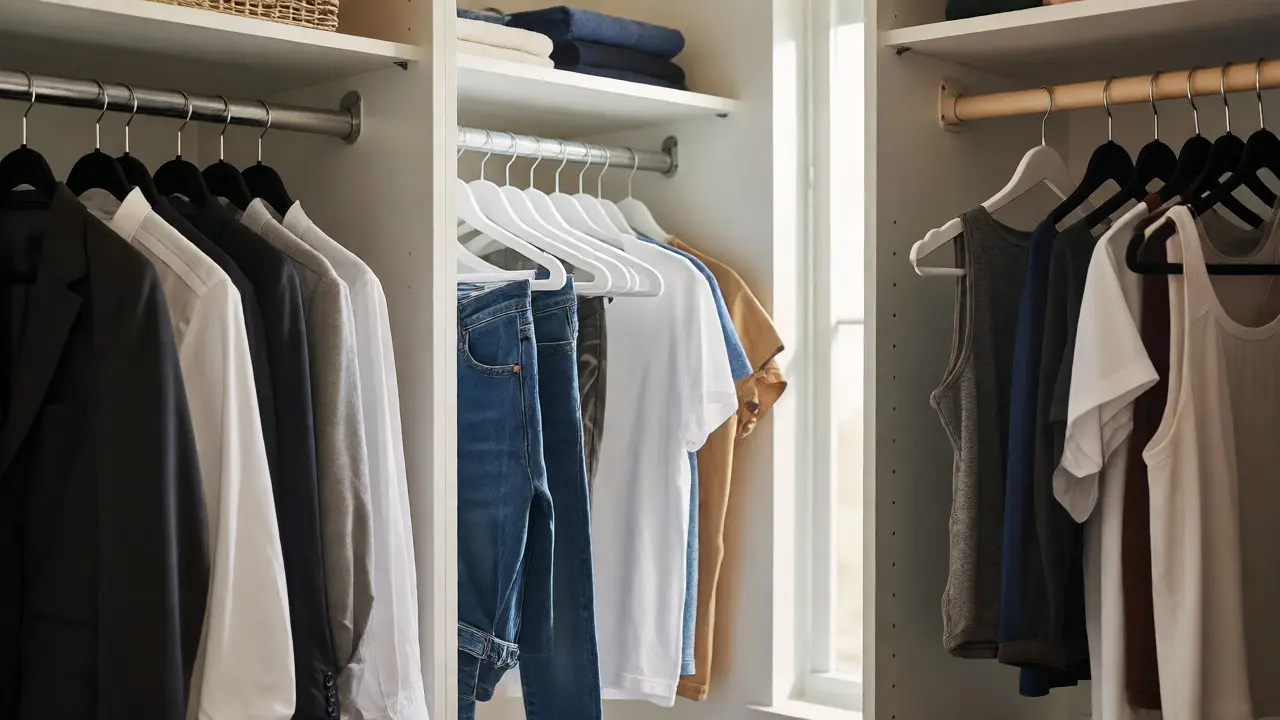
Physical Implementation: Rods, Shelves, and Bins
Now comes the physical rearrangement. You don’t necessarily need new furniture. You just need to reassign existing spaces. Use vertical dividers or different colored hangers to visually mark the boundaries between zones. For example, use black velvet hangers for the Professional Zone and white plastic hangers for the Casual Zone. When you look at the closet, your eye instantly sees where one section ends and another begins.
For smaller closets, use door organizers or stackable bins to create micro-zones. If you can’t separate the rods, dedicate specific drawers. Drawer one is strictly socks and underwear. Drawer two is active wear. Drawer three is casual tops. Label them if necessary. Labels sound childish, but they enforce discipline. After a month, you won’t need them.
| Closet Type | Recommended Zone Separation | Storage Solution |
|---|---|---|
| Walk-in | Dedicated sections per wall or island | Modular shelving systems (e.g., Elfa, PAX) |
| Reach-in (Wide) | Left side vs. Right side division | Hanger types + Shelf dividers |
| Reach-in (Narrow) | Top rod vs. Bottom rod or Door hooks | Stackable bins + Over-door racks |
| Apartment/Small Space | Visual cues via hangers/bins | Vacuum bags for off-season + Clear boxes |
The Outfit Formula Within Each Zone
Zoning solves the "where is it" problem. But you still need to know "what goes with what." To speed this up further, adopt a capsule approach within each zone. Limit your Professional Zone to a set number of compatible tops and bottoms. A standard rule is three bottoms for every one top, or vice versa, depending on your preference.
Create "Go-To Outfits" and photograph them. Hang a small binder or use a digital app like Cladwell or Acloset to store these combos. When you enter your Work Zone, you aren’t browsing; you’re selecting a pre-approved combination. This removes the last layer of friction. If you’re tired or running late, you grab Outfit #4 from your phone and execute. No thinking required.

Maintenance: The One-In-One-Out Rule
A zoned closet collapses if you throw random items back into the wrong spot. You must enforce strict maintenance. Adopt the one-in-one-out rule. If you buy a new pair of running shoes, donate an old pair. If you add a new blazer, remove one that no longer fits the zone criteria.
Schedule a monthly "Zone Reset." Spend fifteen minutes checking each zone. Are there stray items? Move them immediately. Is the Active Zone overflowing? You might need to rotate seasonal gym clothes out. This low-effort maintenance prevents the chaos from creeping back in. Remember, the goal is efficiency, not perfection. If a zone looks messy but functions fast, it’s fine. If it looks perfect but takes ten minutes to navigate, fix it.
Troubleshooting Common Zoning Issues
What if you have a multi-purpose room? What if you share a closet with a partner? These scenarios require slight adjustments.
For shared closets, assign vertical halves. You get the left, they get the right. Within your half, apply zoning. This respects individual habits without requiring separate rooms. For small apartments where the closet is tiny, consider moving off-season items to under-bed storage or high shelves. Keep only the current season’s zones accessible. This reduces visual clutter and makes the remaining zones feel larger.
If you find yourself constantly crossing zones (e.g., wearing a gym hoodie to the grocery store), reconsider your definitions. Maybe your "Active" zone needs to merge with "Casual" if you wear athleisure everywhere. Flexibility is key. The system serves you, not the other way around.
Do I need to buy new hangers for closet zoning?
No, you don't need expensive new hangers, but using distinct hangers for each zone helps visually. Many people use cheap plastic hangers for casual wear and nicer wooden or velvet hangers for work clothes. The contrast acts as a quick visual cue so you know which zone you're looking at without reading labels.
How many zones should I have in my closet?
Three to four zones are ideal for most people. Too few zones defeat the purpose of reducing decision fatigue, while too many zones become hard to maintain. Start with Work, Casual, and Active. Add a fourth zone for Formal or Seasonal items only if you have enough space and use those categories regularly.
What if I work from home but have meetings?
Create a hybrid zone called "Smart Casual" or integrate your meeting clothes into the Work Zone. Since you are physically at home, you might not need full suits, but you still need presentable tops. Keep these items easily accessible near the center of the closet so you can grab them quickly before a video call starts.
Can closet zoning help with laundry?
Yes. When you fold or hang laundry, you return items directly to their designated zone. This prevents the "doom pile" on the chair. Because each item has a specific home based on its function, putting away clothes becomes a rapid sorting task rather than a complex organization project.
Is closet zoning suitable for small wardrobes?
Absolutely. Small wardrobes actually benefit more because every inch counts. With fewer items, zoning ensures that nothing gets lost or forgotten. You maximize utility by ensuring every piece in the closet serves a current, active role in your daily life.


Write a comment