

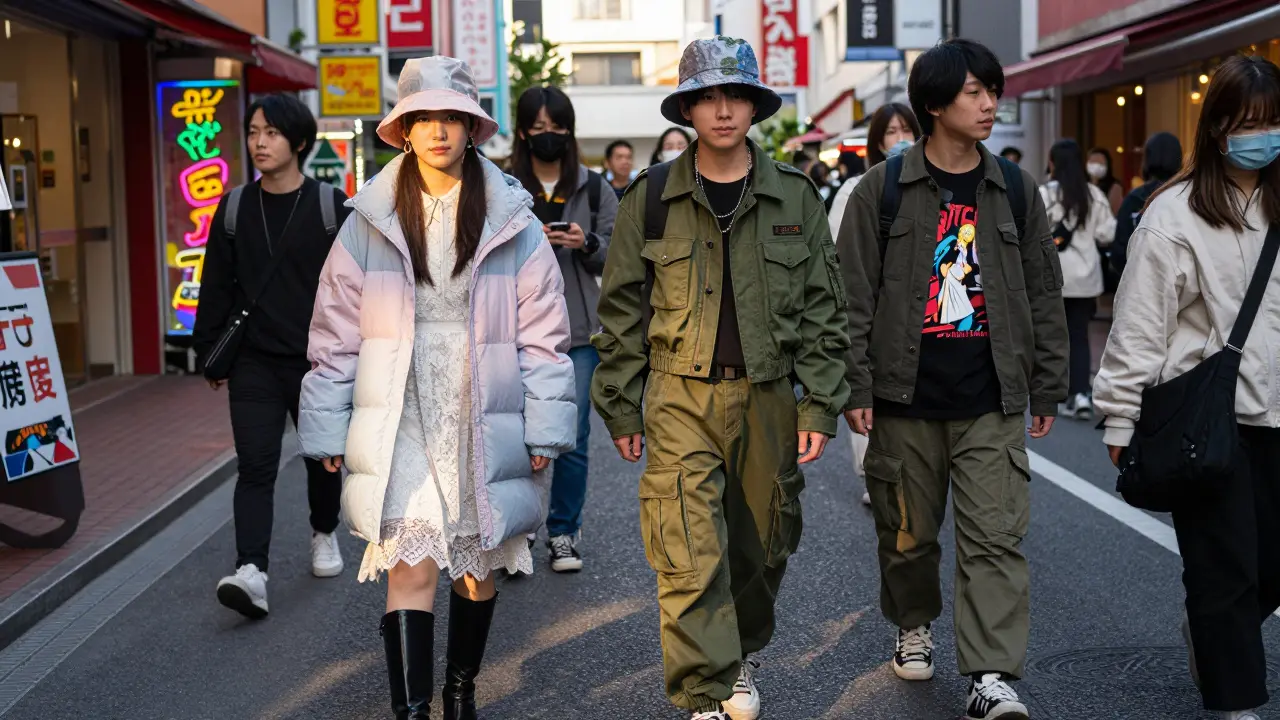
Walk into Harajuku on a weekend and you’ll see fashion that doesn’t ask permission. It doesn’t follow rules. It doesn’t care if you understand it. A 17-year-old in a pastel puffer coat over a lace dress, mismatched knee-high boots, and a bucket hat made of recycled plastic bags walks past someone in a cropped military jacket, cargo pants with 12 pockets, and a vintage anime tee. No one blinks. This isn’t a runway. This is everyday life in Tokyo’s most famous fashion district - and it’s changed how the world thinks about clothing.
Where Harajuku Style Comes From
Harajuku isn’t just a neighborhood. It’s a cultural pressure cooker. In the 1980s, Tokyo’s youth started using clothing as a language. After Japan’s economic boom, teens had money, freedom, and zero interest in copying Western trends. They didn’t want to look like American pop stars or European models. They wanted to build identities from scraps - thrift store finds, handmade accessories, anime merch, and DIY alterations.
By the 1990s, Harajuku had split into distinct tribes: Decora piled on colorful hair clips and plastic toys; Lolita turned Victorian dresses into fantasy wardrobes; Gyaru embraced bleached hair and thick eyeliner; Visual Kei mixed gothic lace with glam rock spikes. These weren’t just trends - they were subcultures with their own rules, meeting spots, and magazines. Today, those roots still shape what you see on the streets.
The Art of Layering
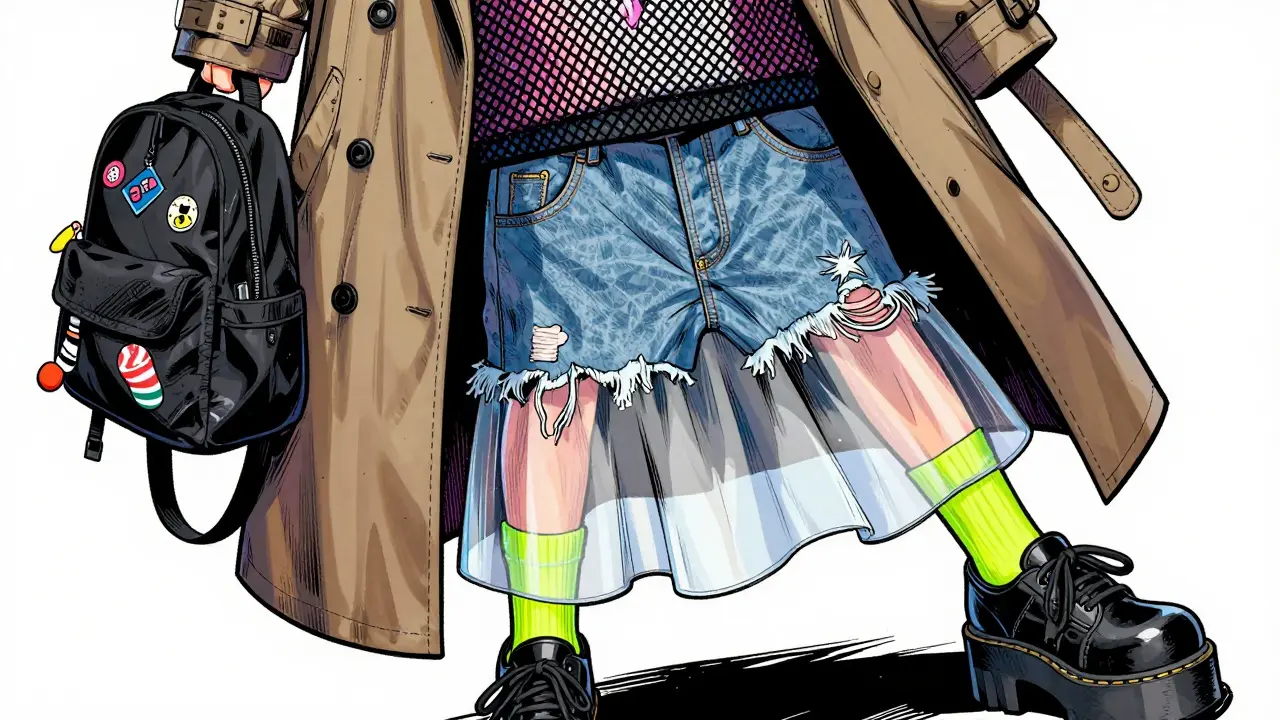
Western fashion often says: one statement piece, clean lines, minimalism. Harajuku says: stack it. Layer it. Overlap it. Confuse it. A single outfit might include five layers - a cropped hoodie under a long trench, over a turtleneck, with a mesh top peeking through, and a sheer skirt on top. It’s not random. It’s calculated chaos.
Why layer like this? First, it’s practical. Tokyo winters are damp and cold. A single coat won’t cut it. But more than that, layering is storytelling. Each layer has meaning. The lace undershirt? A nod to childhood anime. The oversized denim jacket? Found at a flea market in Shimokitazawa. The neon socks? Bought from a 24-hour kiosk in Shibuya.
Studies from Tokyo’s Fashion Institute show that 78% of Harajuku-style outfits use at least three distinct layers. The average outfit has five. Compare that to Paris or New York, where the average is 1.7. It’s not about being flashy. It’s about showing your history - your moods, your obsessions, your contradictions - all in one look.
How Harajuku Changed Global Fashion
Before 2010, global brands mostly ignored Harajuku. Then, in 2011, H&M released a collaboration with a Harajuku designer. Sales jumped 40% in Asia. Within two years, Zara, Uniqlo, and even Gucci started borrowing elements: oversized silhouettes, mixed textures, bold color blocking. But they missed the point. Harajuku isn’t about buying a "Japanese-inspired" jacket. It’s about how people use clothes.
Take the baggy pants trend. In 2015, American streetwear brands started copying the wide-leg cargo pants worn by Harajuku teens. They called it "athleisure." But in Tokyo, those pants weren’t about comfort. They were about rebellion - a rejection of tight, body-conscious Western styles. The pockets? Not for phones. For carrying manga, snacks, and handmade pins.
Even luxury brands got it wrong. Chanel tried to replicate Lolita aesthetics in 2018. The collection sold out - but Japanese teens didn’t wear it. Why? Because it was too polished. Too expensive. Too clean. Harajuku fashion thrives on imperfection. A frayed seam. A mismatched button. A stain from a spilled drink. Those aren’t flaws. They’re badges.
Modern Harajuku: Digital Influence and Sustainability
Today’s Harajuku isn’t just about what you wear. It’s about how you get it. Social media turned street style into a global spectacle. Instagram accounts like @harajuku_style have over 1.2 million followers. But the real shift? The rise of secondhand.
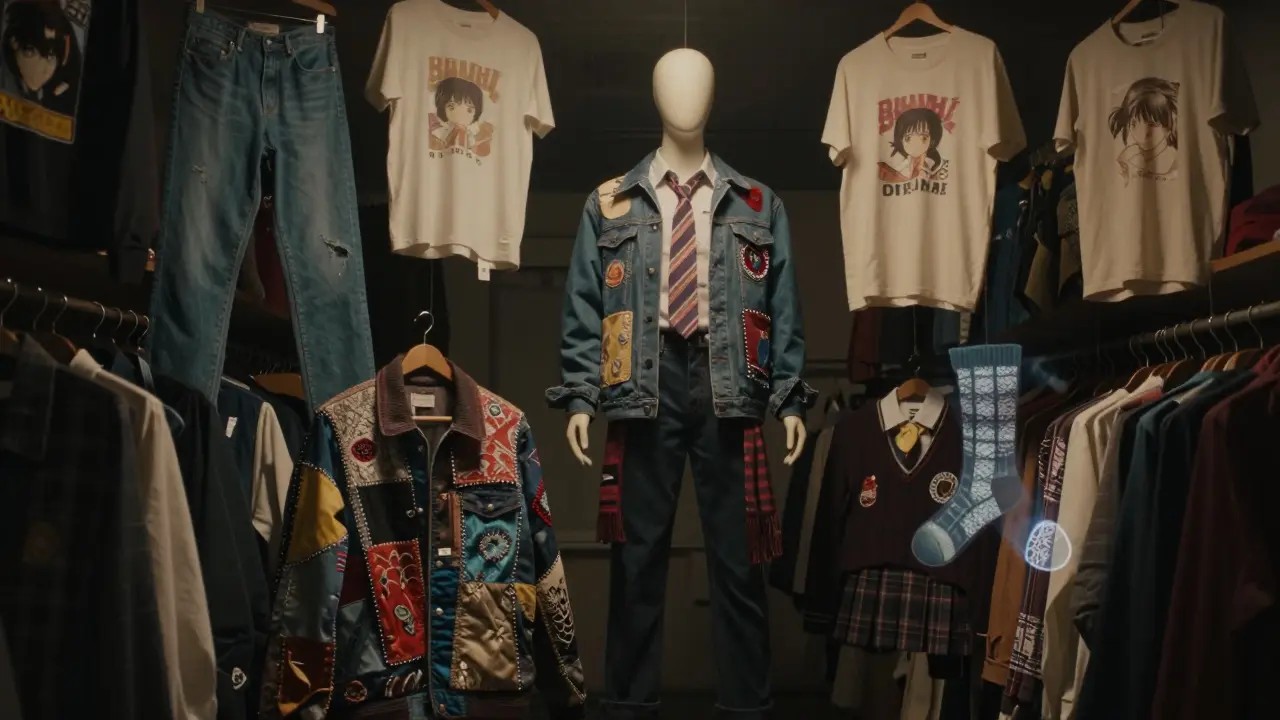
Thrift stores like Hard Off and Tokyu Hands are now fashion labs. Teens spend hours digging through piles of deadstock 90s Levi’s, vintage Bandai t-shirts, and discontinued Japanese school uniforms. The average Harajuku teen owns 14 clothing items they bought secondhand - nearly half their wardrobe. They repair, dye, patch, and upcycle. A 2024 survey found that 63% of Harajuku shoppers refuse to buy new clothes unless they can’t find the item used.
This isn’t just eco-friendly. It’s cultural. The idea of "new" doesn’t mean "better." In fact, the older the item, the more value it holds. A 1992 Kawaii hoodie with a faded print is worth more than a brand-new one. It carries history. Memory. A story.
Why This Matters Outside Japan
Most people think Harajuku is about being weird. It’s not. It’s about being free. Free from trends. Free from brands. Free from the idea that fashion has to make sense. In a world where fast fashion pushes the same 5 styles on everyone, Harajuku says: make your own.
That’s why it’s spreading. In Berlin, teens are reviving Decora with LED hair clips. In Mexico City, students are mixing Lolita skirts with traditional embroidery. In Seattle, where I live, you’ll see girls wearing layered denim over lace, just like in Takeshita Street - but with local band patches sewn on.
Harajuku didn’t invent street style. But it redefined it. It proved that clothing doesn’t need to be expensive, perfect, or even coherent to be powerful. All it needs is intention. And a little bit of chaos.
How to Try It Without Looking Like a Costume
You don’t need to fly to Tokyo to borrow from Harajuku. Start small. Here’s how:
- Find one thrifted piece you love - maybe a vintage school blazer or a faded graphic tee.
- Layer it over something unexpected. Try a turtleneck under a crop top. Or a mesh top under a flannel.
- Add one bold accessory. Not a whole outfit. Just one: neon socks, a chain belt, a stuffed animal pin.
- Don’t match. Let colors clash. Let textures fight. If it feels off, it’s probably right.
- Wear it once. Then modify it. Cut the sleeves. Dye it. Sew on a patch. Make it yours.
Harajuku style isn’t about copying. It’s about collecting fragments - of music, memory, rebellion - and stitching them into something only you could wear.
Is Harajuku fashion still relevant today?
Yes, more than ever. While the 2000s versions of Decora and Lolita have faded, their spirit lives on in modern layering, secondhand customization, and gender-fluid styling. Today’s Harajuku teens aren’t wearing anime shirts because they’re obsessed with cartoons - they’re wearing them because they’re reclaiming nostalgia as a form of self-expression. The district still draws 300,000 visitors monthly, and local designers report 20% year-over-year growth in sales of handmade, upcycled pieces.
Can you wear Harajuku style without being Japanese?
Absolutely. Harajuku style was never about ethnicity - it was about rebellion. It started with Japanese teens rejecting Western fashion norms. Today, it’s a global language of individuality. People in São Paulo, Lagos, and Toronto use Harajuku principles to express their own identities. The key is respect: don’t copy sacred subculture symbols (like traditional Lolita headpieces) without understanding their meaning. Borrow the attitude, not the costume.
What’s the difference between Harajuku and Kawaii fashion?
Kawaii means "cute" in Japanese, and it’s a visual aesthetic - pastels, bows, cartoon characters. Harajuku is the movement that uses Kawaii, but also mixes it with punk, goth, streetwear, and avant-garde styles. You can be Kawaii without being Harajuku (think Hello Kitty merch). But if you’re layering a Kawaii dress with combat boots and a chain wallet? That’s Harajuku. Kawaii is a color. Harajuku is the whole painting.
Why do Harajuku teens wear mismatched socks?
It’s not about fashion. It’s about control. In a society that values conformity - from school uniforms to corporate dress codes - wearing mismatched socks is a tiny act of defiance. It says: I won’t follow the rules, even on the smallest level. Many teens buy socks in bulk, then intentionally pair them for contrast. One striped, one polka-dotted. One bright pink, one charcoal gray. It’s playful, yes. But also political.
Is Harajuku fashion expensive?
Not at all. Most Harajuku outfits cost less than $100 total. The average teen spends $15 a month on clothing - mostly from thrift stores or discount chains like Don Quijote. A single piece might cost $3. A full layered look? $60. Luxury brands are rare. What matters isn’t the price tag - it’s the story behind the item. A $2 vintage jacket with a hand-stitched patch from a friend’s art project is worth more than a $300 designer coat.


Write a comment