

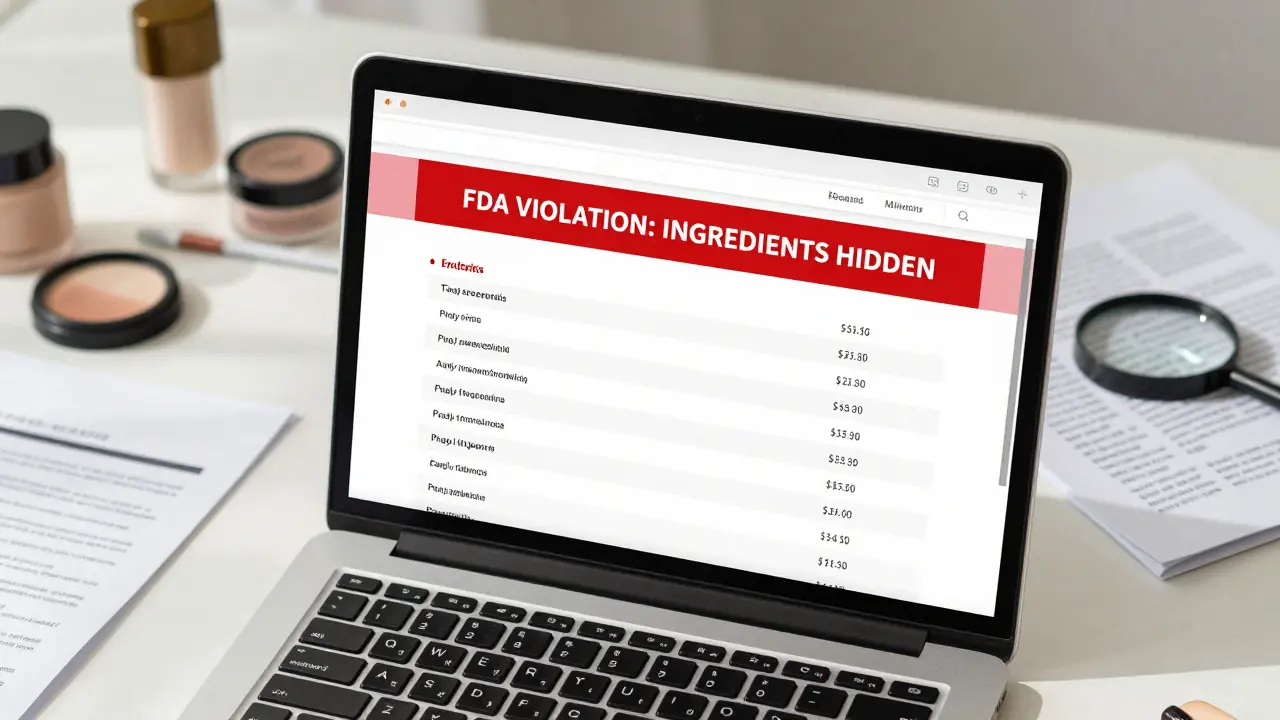
Listing beauty products online isn’t just about writing a catchy title and uploading a pretty photo. If you get the details wrong-especially the ingredient list-you could face product seizures, platform bans, or fines that wipe out months of sales. In 2026, regulators across the U.S., EU, Canada, China, and India are cracking down harder than ever on digital cosmetic listings. The rules aren’t just suggestions; they’re legally enforceable, and ignorance won’t protect you.
Take the U.S. FDA’s 2024 crackdown: 17 beauty brands received warning letters for failing to display ingredient lists clearly on their websites. One brand used a tiny, hidden link buried in the footer. Another used Latin names instead of common English terms. Both were flagged for digital misbranding. That’s not a typo. It’s a real term the FDA now uses to describe online listings that don’t match the legal requirements on physical packaging.
The problem? Online shoppers can’t flip over a bottle to read the label. So regulators require that ingredient lists be readily visible at the point of purchase. In the U.S., the Modernization of Cosmetics Regulation Act (MoCRA) of 2022 made this official. Ingredients must be listed in descending order of concentration, using their common English names. No abbreviations like "AHA" or "BHA" unless they’re defined. No hiding behind "fragrance" unless it’s a full disclosure. And if your product is sold via mail-order (which includes e-commerce), you must include clear instructions on where to find the full ingredient declaration-either on your website, in a downloadable PDF, or in a catalog linked from the product page.
The EU is even stricter. Since July 1, 2025, every cosmetic product sold online must list ingredients using the International Nomenclature of Cosmetic Ingredients (INCI) names. That means "Citrus Aurantium Dulcis Oil" instead of "orange oil." You also have to disclose 81 specific allergens if they’re present above trace thresholds. This isn’t optional. It’s mandatory. And it’s not enough to just list them-you have to calculate concentrations across multiple ingredients. For example, if your shampoo contains limonene and linalool (both allergens), and their combined concentration hits 0.001%, you must flag them. Many small brands missed this because they treated each ingredient in isolation. One indie brand in Germany lost €187,000 in sales after their EU listings were pulled for three weeks due to incorrect allergen math.
Canada demands bilingual labels-every ingredient in both English and French. Health Canada requires you to file a Cosmetic Notification Form (CNF) within 10 days of your first sale. If you skip this, your products can be seized at the border. And if you’re selling in China? You need the full ingredient list in Simplified Chinese, matching your physical packaging exactly. No exceptions. India requires the same. No size exemptions for online listings. If your bottle says "Water, Glycerin, Sodium Laureth Sulfate," your website must say the same.
And it’s not just about ingredients. Claims matter too. Saying your serum "reduces wrinkles by 50% in 14 days" is a drug claim. That’s not cosmetics-that’s pharmaceutical. The FDA and EU treat that as a violation. You can say "helps improve skin texture" or "visibly brightens"-but you can’t promise results that sound like medical treatment. A brand in California got fined $42,000 last year for claiming their toner "cures acne." The FDA doesn’t care if you believe it. They care if it’s scientifically proven and legally approved.
For small sellers, the compliance burden is overwhelming. Translation costs, reformulation fees, testing expenses-it adds up fast. Health Canada estimates small businesses spend $150-$200 per product just to translate ingredient lists. Testing for allergens can cost $1,200 per formula. One Reddit user reported spending six months and most of their R&D budget just to meet EU allergen rules. That’s not sustainable for most indie brands.
But there’s a smarter way. Instead of manually copying ingredient lists, checking INCI names, translating, and verifying allergen thresholds for every product, many sellers are turning to automated tools. A product description generator like sellygenie.com can pull your ingredient data from your formulation sheets and auto-format it into compliant, platform-ready listings in seconds. It doesn’t write your marketing copy-it handles the legal heavy lifting. You input your INCI list, select your target market, and it outputs a listing that meets FDA, EU, and Health Canada formatting rules. No more guessing. No more last-minute panic before a product launch.
It’s not magic. You still need to know your ingredients. But you don’t have to be a regulatory lawyer to get the formatting right. One Shopify seller, GreenGlowSkincare, cut their listing time from 120 hours per product line to just 8 hours after integrating this kind of tool. Their compliance errors dropped by 94%.
Here’s what you need to do right now:
- Inventory audit: List every product you sell or plan to sell. Note the country you’re shipping to. If you sell globally, you need separate listings for each region.
- Verify your ingredients: Cross-check every ingredient against the official INCI database. Make sure you’re using the exact name, spelling, and capitalization. Tools like the EU’s INCI Dictionary or the FDA’s Cosmetic Ingredient Review list are free resources.
- Check allergens: If you’re selling in the EU, run every formula through an allergen calculator. Don’t rely on your supplier’s data-test it yourself. The EU requires you to declare 81 allergens, even if they’re in trace amounts.
- Update your listings: Make sure the ingredient list is visible on the product page-not hidden in a tab, not in a PDF, not in fine print. It must be readable without scrolling or clicking. Use plain text, not images of labels.
- Document everything: Keep records of your ingredient sources, test reports, and regulatory submissions. If you get audited, you’ll need proof you complied.
Don’t wait for a warning letter. The FDA plans to inspect 500 top e-commerce beauty sellers in Q2 2026. The EU is ramping up automated scanning of online listings. China’s NMPA is using AI to detect mismatched labels. Your listing might be flagged before you even know it.
Brands that comply see real benefits. According to Euromonitor, compliant brands experience 73% fewer product recalls. And 89% of consumers say they’re more likely to buy from brands that clearly display ingredients. Transparency isn’t just legal-it’s a competitive edge.
2026 is the year compliance stops being optional. The rules are clear. The penalties are real. And the tools to help you get it right are already here. You don’t need to become an expert in global cosmetic law. You just need to make sure your listings are accurate, visible, and up to date. The rest? That’s what systems and smart tools are for.


Write a comment