

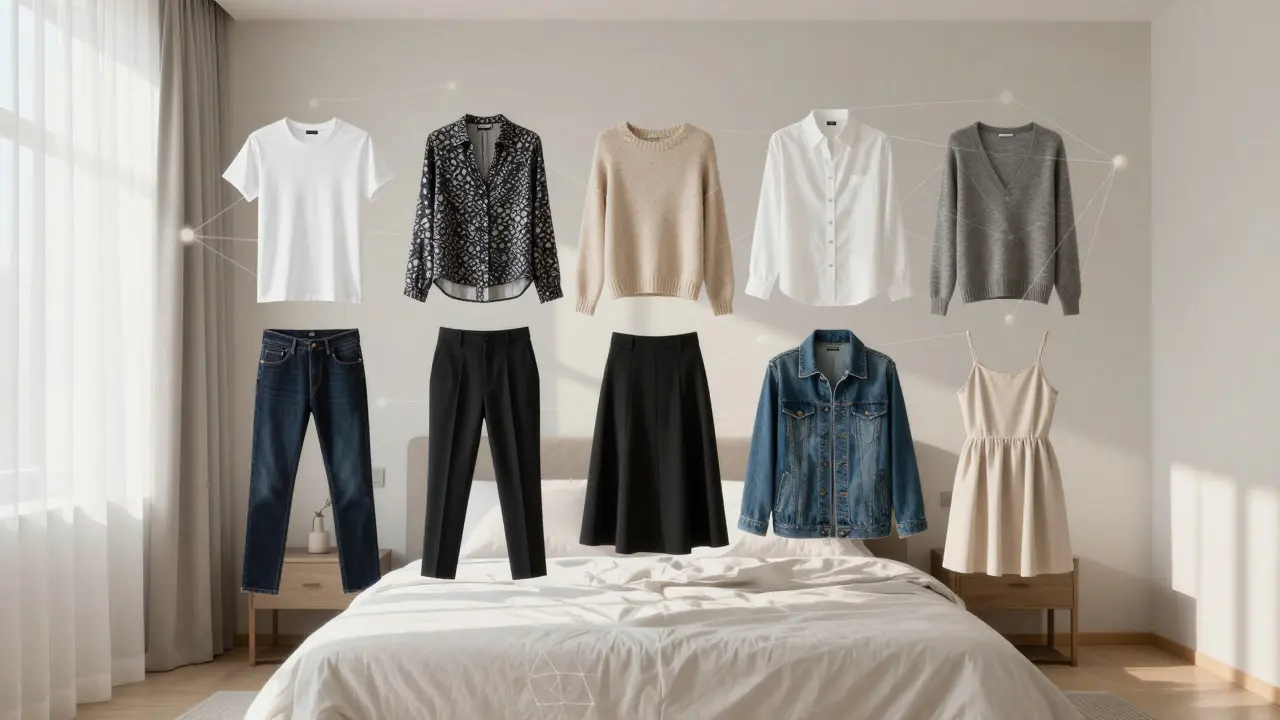
You stand in front of your closet, staring at a mountain of clothes, and you still feel like you have nothing to wear. It’s a frustrating paradox that millions of people face every morning. But what if the solution wasn’t buying more, but understanding how to combine what you already own? The secret lies not just in aesthetics, but in mathematics. Specifically, it’s about combinatorics-the branch of math dealing with counting and arranging items.
Creating thirty distinct outfits from fewer than ten pieces sounds impossible if you think linearly. If you had five tops and five bottoms, simple multiplication gives you twenty-five options. That’s close, but not quite thirty. However, by introducing layers, accessories, and strategic color coordination, you can exponentially increase your possibilities without adding bulk to your wardrobe. This approach transforms dressing from a daily chore into a satisfying puzzle of efficiency and style.
The Combinatorial Power of Mixing and Matching
To understand how few pieces can create so many looks, we need to look at the basic formula for outfit creation. In its simplest form, an outfit consists of a top and a bottom. If you have 5 tops and 5 bottoms, the number of combinations is calculated by multiplying the two numbers: $5 \times 5 = 25$ outfits. This is where most people stop. They buy five shirts and five pairs of pants, realize they only have 25 options, and decide they need more clothes.
But real life isn’t just tops and bottoms. We layer. We accessorize. We change shoes. Let’s add a third variable: outerwear or layers. If you introduce 2 versatile jackets (like a denim jacket and a blazer) that can be worn over any top-bottom combination, you aren’t just adding two outfits. You are doubling your existing options. Now, for each of those 25 base outfits, you have three choices: no jacket, jacket A, or jacket B. The math shifts from simple addition to exponential growth. $25 \text{ base outfits} \times 3 \text{ layering options} = 75$ potential variations.
This demonstrates why a capsule wardrobe relies on high-interchangeability items rather than specialized ones. A dress that only goes with one specific pair of shoes is a dead end in this mathematical model. A white t-shirt that works with jeans, skirts, trousers, and shorts is a multiplier. The goal is to maximize the "connectivity" between items. Every piece should ideally work with at least 60% of the other items in your collection.
Selecting the Right Ten Pieces for Maximum Variety
Knowing the math is useless if your pieces don’t actually match. To hit that target of 30+ outfits, you need to curate your ten items with extreme precision. Random selection leads to gaps; strategic selection creates a web of possibilities. Here is a breakdown of a highly efficient ten-piece kit designed for maximum combinatorial output:
- 4 Tops: One neutral t-shirt (white or black), one patterned blouse, one long-sleeve knit, and one structured button-down. These cover casual, professional, and transitional needs.
- 3 Bottoms: One pair of dark denim jeans, one tailored trouser, and one midi skirt. These provide variety in silhouette while maintaining a cohesive color palette.
- 2 Layers: One oversized cardigan or blazer, and one lightweight utility jacket or denim jacket. These add texture and warmth without clashing.
- 1 Dress/Jumpsuit: A slip dress or a simple jumpsuit that can be worn alone or layered over/under other items. This acts as a wildcard that breaks the top/bottom mold.
Notice the emphasis on neutrals and classic cuts. Trendy items often have limited compatibility because their colors or shapes are too specific. A bright neon green shirt might look great, but if it clashes with your jeans, your trousers, and your skirt, it has a connectivity score of zero. In the world of minimalist fashion, versatility is the ultimate luxury. By sticking to a cohesive color palette-such as navy, black, white, beige, and grey-you ensure that almost any top can go with any bottom.
The Role of Accessories in Exponential Growth
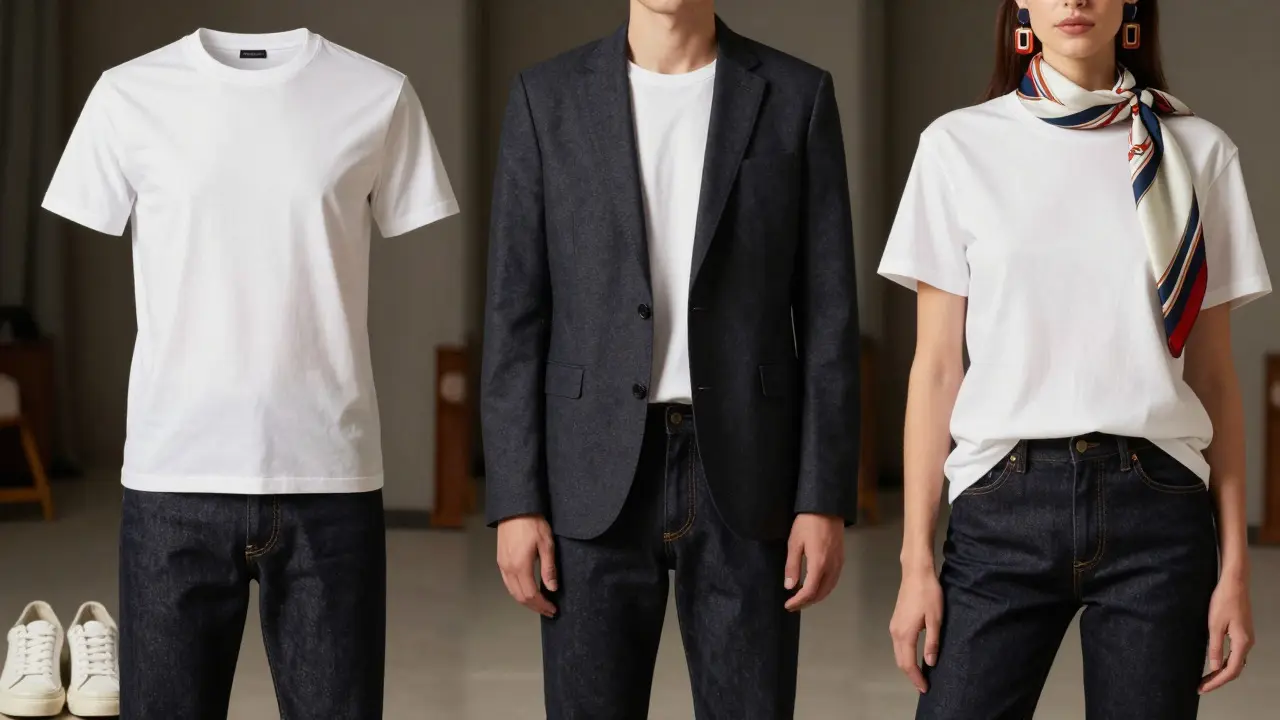
If clothing provides the base combinations, accessories are the multipliers that push you past the thirty-outfit threshold. Many people underestimate the impact of small changes. Swapping sneakers for loafers doesn’t just change your footwear; it changes the entire vibe of the outfit from casual to smart-casual. Adding a silk scarf, a belt, or statement earrings can make the same top-and-bottom combo feel entirely new.
Let’s refine our math. Take one base outfit: a white t-shirt and blue jeans. Without accessories, it’s just one look. Now, consider these variables:
- Footwear: Sneakers, Boots, Heels (3 options)
- Outerwear: None, Blazer, Denim Jacket (3 options)
- Accessories: Minimalist necklace, Bold earrings, Scarf (3 options)
Even if you don’t use all variables simultaneously, the permutations grow rapidly. $3 \times 3 \times 3 = 27$ variations from a single top-and-bottom pair. When you apply this logic across your entire ten-piece wardrobe, the number of unique ways to present yourself becomes astronomical. This is why accessorizing is a critical component of capsule wardrobe strategy. It allows you to adapt a single outfit for different occasions-a lunch date, a office meeting, or a weekend errand run-without needing separate sets of clothes.
| Component | Number of Items | Combinatorial Impact | Example Variations |
|---|---|---|---|
| Base Tops & Bottoms | 7 items (4 tops, 3 bottoms) | Multiplicative ($4 \times 3$) | 12 core outfits |
| Outerwear/Layers | 2 items | Additive to Multiplicative | Doubles/Triples core outfits |
| Footwear | 3 pairs | Style Shifter | Casual vs. Formal tones |
| Jewelry/Scarves | 5+ items | Permutational | Personalization & uniqueness |
Avoiding Common Pitfalls in Capsule Planning
While the math promises abundance, reality can be messy. The biggest mistake people make when building a capsule wardrobe is ignoring fit and fabric quality. A cheap t-shirt that pills after two washes loses its versatility quickly. If one piece falls out of rotation because it doesn’t look good, your entire combinatorial structure collapses. For example, if your only white t-shirt shrinks, you lose 25% of your top options, which significantly reduces your total outfit count.
Another pitfall is neglecting seasonality. A ten-piece summer wardrobe won’t work in New York winters unless you account for heavy layering. In colder months, your "layers" category needs to include coats and sweaters that are thick enough to provide warmth but thin enough to not look bulky under outerwear. The key is to plan your capsule around your actual climate and lifestyle. If you work from home, you might prioritize comfort-focused fabrics like cotton and modal. If you commute via subway, you might choose wrinkle-resistant materials.
Also, beware of the "special occasion" trap. Don’t include a dress that you’ll only wear once a year. Instead, focus on pieces that can be dressed up or down. A little black dress is a classic example-it can be worn with sandals for a day out or with heels and jewelry for dinner. This dual-purpose nature is what makes a capsule wardrobe sustainable in both financial and environmental terms.

Sustainability and the Psychology of Less
Beyond the math, there is a profound psychological benefit to wearing fewer clothes. Decision fatigue is real. Every morning, you make hundreds of micro-decisions. Choosing what to wear is one of the first and most visible. By limiting your options to a curated set of high-quality, interchangeable pieces, you reduce cognitive load. You spend less time scrolling through racks and more time living your life.
From an environmental perspective, sustainable fashion advocates for reducing consumption and extending garment lifespans. The fast fashion industry thrives on the idea that you always need something new. Capsule wardrobes challenge this narrative. By getting more mileage out of each piece, you reduce waste and lower your carbon footprint. Buying ten well-made items that last for years is far better for the planet than buying fifty cheap items that end up in landfills within months.
This shift also encourages mindfulness. When you know exactly what you own and how it fits together, you become more intentional about purchases. Before buying anything new, you ask: "Does this work with at least six other items in my closet?" If the answer is no, you walk away. This discipline leads to a wardrobe that feels less like a storage unit and more like a personal uniform designed for ease and confidence.
Building Your Own Combination Matrix
To start applying this yourself, try creating a physical or digital matrix. Lay out your ten chosen pieces on a bed or floor. Take photos of every possible combination. You might be surprised by how many outfits emerge. Use a spreadsheet or a styling app to track which combinations work best. Over time, you’ll identify your "power pieces"-the items that generate the most successful outfits-and invest in similar styles in the future.
Remember, the goal isn’t to restrict yourself, but to liberate yourself from the chaos of choice. With careful planning and a bit of math, you can prove that less truly is more. Your next purchase shouldn’t be driven by impulse, but by strategy. Ask yourself how each new item fits into the equation. Does it multiply your options, or does it just add clutter? The answer will guide you toward a wardrobe that is not only stylish but also smart, sustainable, and deeply satisfying.
How many outfits can you really get from 10 pieces?
With a well-curated capsule wardrobe of 10 pieces, you can easily create 30 to 50+ unique outfits. This depends on how many items are interchangeable. Using the formula of tops x bottoms x layers, and adding accessories, the combinations grow exponentially. For example, 4 tops and 3 bottoms give 12 base outfits. Add 2 layers and 3 footwear options, and the possibilities multiply significantly beyond the initial count.
What are the best colors for a capsule wardrobe?
Neutral colors are the foundation of a successful capsule wardrobe. Stick to a palette of black, white, navy, grey, beige, and olive. These colors mix and match effortlessly, ensuring that almost any top can be paired with any bottom. You can add one or two accent colors for personality, but keep them secondary to maintain maximum interchangeability.
Can a capsule wardrobe work for formal events?
Yes, if you choose versatile pieces. A tailored blazer, a slip dress, and elegant trousers can be dressed up with heels and jewelry for formal events. The key is to select items that have a clean, polished silhouette. Avoid overly casual fabrics like distressed denim for your core pieces if you need formal flexibility.
How do I avoid boredom with a small wardrobe?
Boredom usually comes from lack of variation in styling. Use accessories like scarves, belts, and jewelry to change the look of the same outfit. Experiment with different layering techniques, such as tying a sweater around your shoulders or rolling up sleeves. Rotating seasonal accessories can also refresh your look without buying new clothes.
Is it expensive to build a capsule wardrobe?
Initially, it might seem costly because you’re investing in higher-quality items. However, in the long run, it saves money. You buy fewer items overall, and they last longer. Plus, you stop wasting money on impulse buys that you never wear. Start by auditing what you already own before purchasing anything new.